
What I've Learned About Digital Transformation After Leading Large-Scale Website Migrations
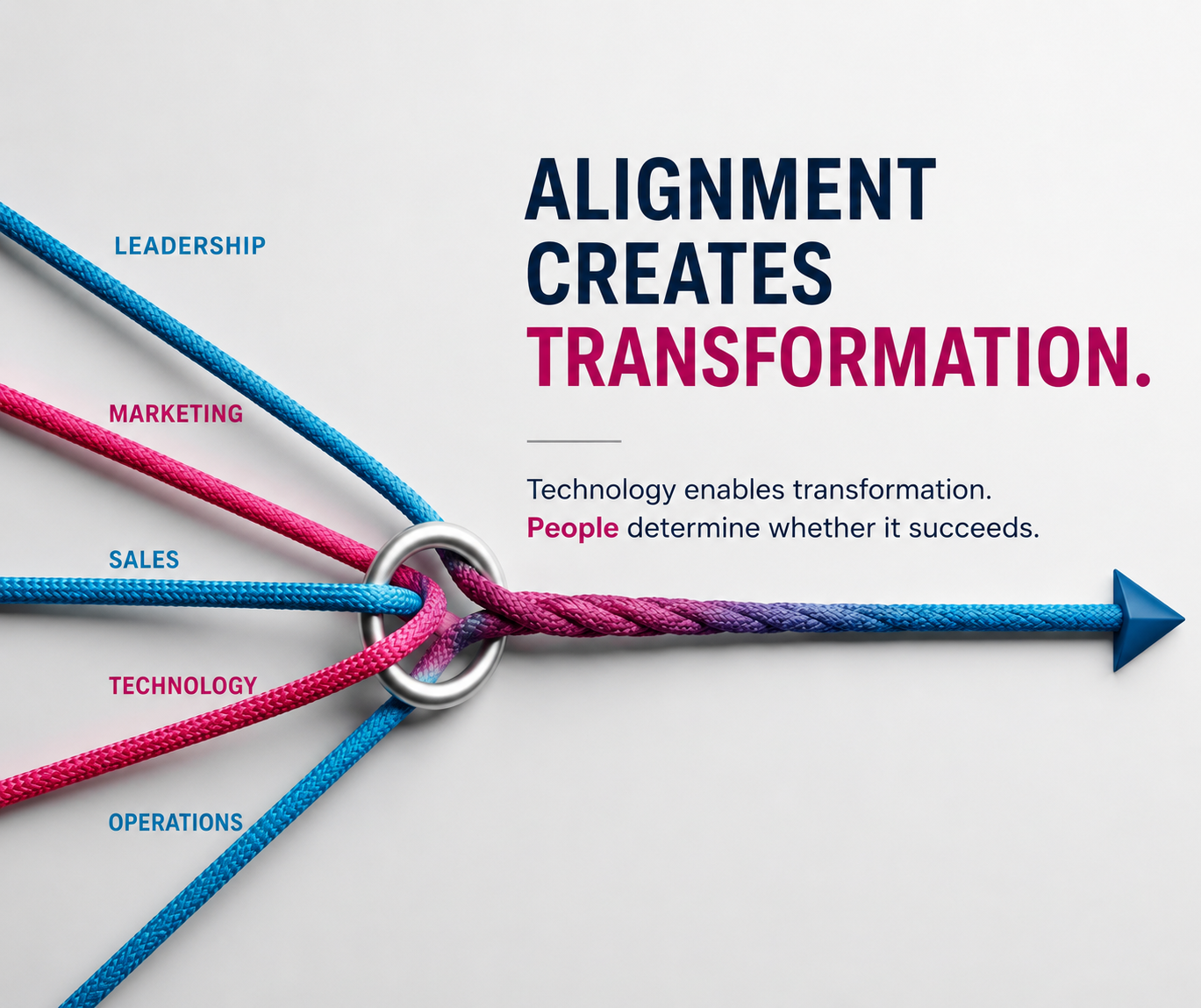
Over the past several years, I've had the opportunity to lead and support large-scale digital initiatives involving multiple brands, internal teams, agency partners, developers, marketers, and executive stakeholders. While every project has been unique, one lesson continues to surface regardless of industry, platform, or business size.
Successful digital transformation is rarely determined by technology alone. That may sound surprising given how much attention organizations devote to platform evaluations, software capabilities, and technical requirements. Entire initiatives are often built around selecting the right CMS, eCommerce platform, marketing technology stack, or content management process. Those decisions are important, but they are rarely the factor that determines whether a transformation ultimately succeeds or struggles.
What I've learned is that technology is usually the easy part. The more difficult challenge is creating alignment around why the transformation is happening in the first place. When organizations begin discussing a migration or transformation initiative, conversations often focus on replacing systems, improving functionality, reducing technical debt, or modernizing the customer experience. These are all worthwhile goals. However, beneath those objectives are often very different expectations from different parts of the organization.
Marketing teams may see the initiative as an opportunity to improve content management and customer engagement. Sales teams may be focused on lead quality and conversion opportunities. Technology teams are often concerned with scalability, security, performance, and maintainability. Executive leadership may be looking at operational efficiencies, cost savings, or long-term growth opportunities.
Individually, none of these priorities are wrong. In fact, they are all important. The challenge arises when they remain independent priorities rather than becoming part of a shared vision. I've watched projects gain momentum quickly when stakeholders were aligned around common objectives, and I've seen equally talented teams struggle when that alignment was missing. In many cases, the project plan looked solid, the technology was capable, and the resources were available. Yet progress slowed because teams were unknowingly solving different problems.
What makes digital transformation particularly challenging is that it is rarely just a technology initiative. At its core, transformation is an organizational change initiative. New platforms introduce new workflows. New workflows often require new responsibilities. New responsibilities change how teams collaborate, communicate, and make decisions. Even when the technology is an improvement, the process of adapting to change can create uncertainty throughout the organization.
This is why change management becomes just as important as implementation. People naturally become comfortable with familiar processes, even when those processes are inefficient. Asking teams to work differently requires more than training sessions and documentation. It requires helping people understand why change is happening and how it supports larger business objectives.
One of the most effective practices I've seen is establishing a clear definition of success before the project begins. Surprisingly, many organizations spend significant time discussing deliverables and timelines without fully defining the outcomes they expect to achieve.
A launch date is not a business objective.
A platform migration is not a business objective.
Even a new website is not a business objective.
Those are outputs.
The real question is what those outputs are intended to accomplish. Are we trying to improve customer experience? Increase conversions? Reduce operational complexity? Improve content governance? Enable future growth?
When those answers are clearly defined, decision-making becomes significantly easier throughout the life of the project. Teams have a framework for evaluating priorities, resolving disagreements, and maintaining focus when new requests inevitably emerge.
Another lesson I've learned is that complexity often becomes the enemy of progress. Large initiatives naturally attract additional requirements, stakeholders, and opinions. Every request may seem reasonable in isolation, but collectively they can create unnecessary complexity that slows execution and reduces momentum.
The most successful transformations I've participated in shared a common characteristic: they remained focused on what mattered most. Rather than attempting to solve every problem at once, they identified the highest-priority opportunities and aligned the organization around achieving them. That focus created clarity. Clarity created momentum. And momentum ultimately created results.
Looking back across the various transformation initiatives I've been fortunate enough to support, the projects that delivered the greatest value were not necessarily the ones with the largest budgets or the most sophisticated technology. They were the ones where leadership established a clear vision, stakeholders remained aligned, and teams understood how their individual contributions supported a larger objective.
Technology can enable transformation. People ultimately determine whether it succeeds. And in my experience, the organizations that invest in alignment before execution consistently put themselves in the strongest position for long-term success.
